
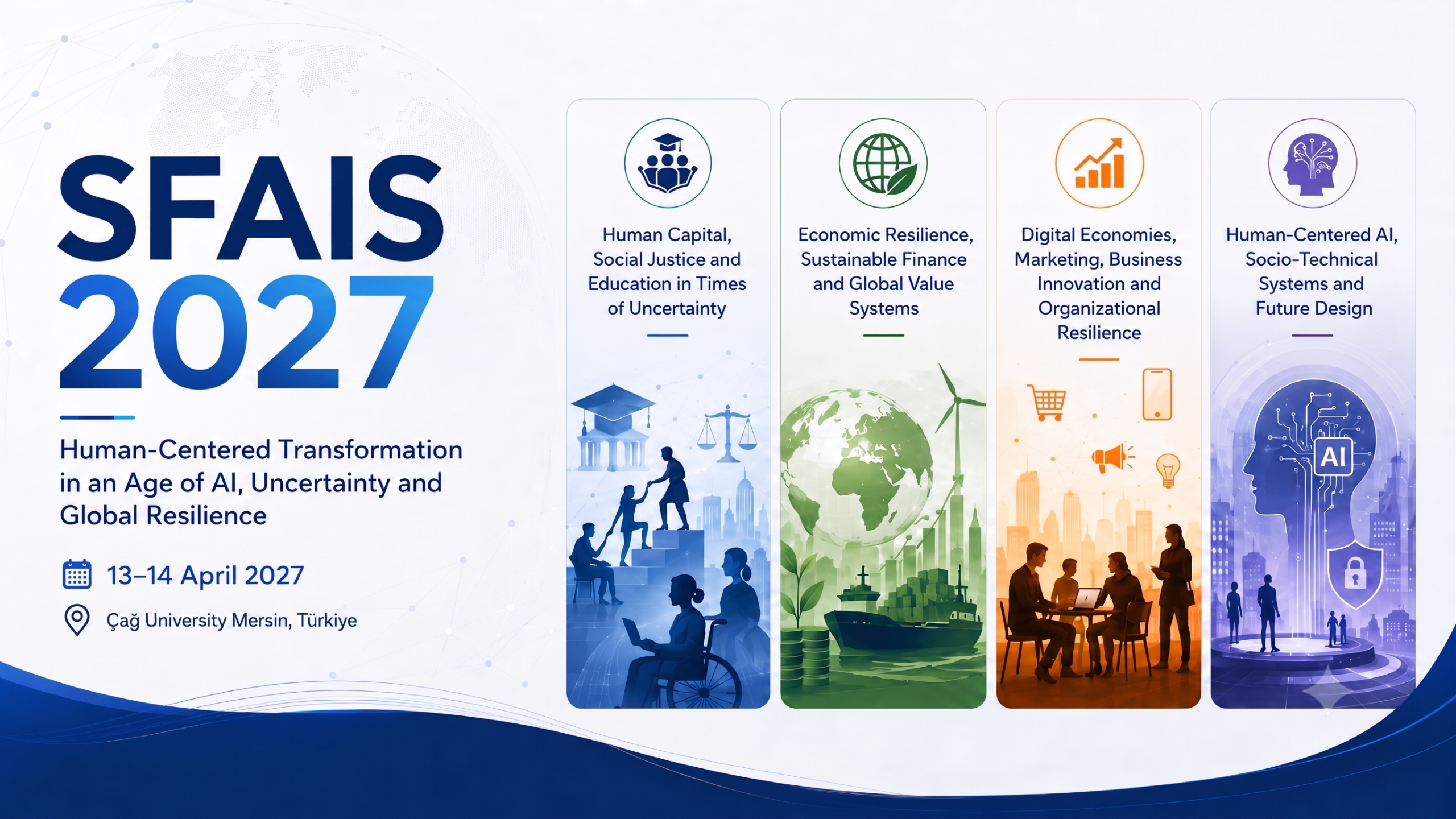

SFAIS 2027
Human-Centered Transformation in an Age of AI, Uncertainty and Global Resilience
Artificial intelligence, digital transformation, geopolitical uncertainty, climate change, economic volatility, demographic shifts, and rapidly evolving technologies are fundamentally reshaping the way people live, work, govern, and innovate. While technological advances continue to accelerate at an unprecedented pace, sustainable and inclusive progress depends not only on technological capability but also on the ability of individuals, organizations, and societies to adapt, collaborate, and create human-centered solutions.
Against this backdrop, the SFAIS 2027 – International Conference on Human-Centered Transformation in an Age of AI, Uncertainty and Global Resilience provides an international interdisciplinary platform for scholars, researchers, practitioners, policymakers, industry leaders, and graduate students to exchange knowledge, present innovative research, and discuss emerging challenges and opportunities in an increasingly complex global environment.
The conference highlights the importance of placing people at the center of technological and societal transformation. Rather than viewing artificial intelligence solely as a technological advancement, SFAIS 2027 encourages discussions on how AI can be designed, governed, and implemented to promote sustainable development, ethical innovation, organizational resilience, economic competitiveness, social justice, and human well-being.
SFAIS 2027 welcomes theoretical, empirical, methodological, and applied research that advances knowledge across disciplines while fostering collaboration between academia, industry, government, and international organizations. Contributions addressing interdisciplinary perspectives, evidence-based policy recommendations, innovative business practices, and technology-enabled societal solutions are particularly encouraged.
The conference welcomes submissions from a broad range of disciplines, including but not limited to:
- Artificial Intelligence and Digital Transformation
- Business Administration and Management
- International Trade and Global Business
- Economics and Finance
- Accounting and Auditing
- Marketing and Consumer Behaviour
- Logistics and Supply Chain Management
- Entrepreneurship and Innovation
- Human Resource Management
- Public Administration and Public Policy
- Governance and Institutional Development
- Sustainability and Circular Economy
- Climate Change and Environmental Management
- Education and Educational Technologies
- Law, Ethics and Digital Governance
- Information Systems and Data Analytics
- Computer Science and Engineering Applications
- Social Sciences and Interdisciplinary Studies
SFAIS 2027 will be organized in a hybrid format (face-to-face and online) by the Faculty of Economics and Administrative Sciences, Çağ University, Türkiye, on 13–14 April 2027. The hybrid format aims to maximize international participation and foster inclusive academic collaboration by bringing together participants from diverse geographical regions and disciplinary backgrounds.
The conference represents the continuation of an international academic initiative originally launched in collaboration with UNITAR and subsequently developed through partnerships with ELARA and EUT+. Building upon this strong international foundation, SFAIS 2027 seeks to expand its global network by connecting established international scholars with emerging regional researchers, practitioners, and institutions, thereby promoting new research collaborations, policy dialogue, and knowledge exchange.
Accepted abstracts will be published in the Conference Abstract Proceedings. Selected high-quality papers will be invited for publication in internationally recognized journals and edited book volumes, subject to each publisher’s peer-review process.
We warmly invite researchers, academics, professionals, policymakers, and students from around the world to join SFAIS 2027 and contribute to shaping a future where technological advancement is guided by human values, ethical responsibility, resilience, sustainability, and global collaboration.
Theme 1 — Human Capital, Social Justice and Education in Times of Uncertainty
This theme explores the role of education in developing human capital, promoting social justice, and strengthening resilience in a world shaped by technological change, economic volatility, geopolitical tensions, conflict, and environmental challenges.
Submission Areas
Trust, Integrity and AI in Education
- Ethical AI in education
- Academic integrity and AI-assisted learning
- Supervision, assessment, and evaluation in the AI era
- Human-centered learning environments
- Learning analytics and responsible educational technologies
Inclusion, Equity and Social Justice
- Educational access and digital inclusion
- Lifelong learning and citizenship
- Diversity, equity, and inclusion in education
- Reducing inequalities through education and technology
- Social justice in higher education and digital learning
Human Capital Development in an Uncertain World
- Future skills and employability
- Resilience, sustainability, and adaptability
- Education, conflict, and peacebuilding
- Human capital development under economic, political, and social uncertainty
- The role of education in sustainable and inclusive development
Theme 2 — Economic Resilience, Sustainable Finance and Global Value Systems
This theme examines how economies, financial systems, trade networks, and global value chains are being reshaped by geopolitical tensions, technological disruption, climate transition, inflationary pressures, and sustainability challenges. It welcomes research on how economic and financial systems can become more resilient, inclusive, sustainable, and adaptive.
Submission Areas
Global Trade, Value Chains and Economic Resilience
- Deglobalization and re-globalization dynamics
- Global value chains and supply chain resilience
- Trade fragmentation and geopolitical economy
- Trade disruptions and regional economic realignment
- Sustainable development economics
- Economic resilience in times of crisis
Climate Economics, Energy Transition and Macroeconomic Stability
- Climate economics and carbon markets
- Energy transition and macroeconomic stability
- Inequality, inflation, and crisis economics
- Sustainable growth and green transition
- Environmental policy and economic transformation
Sustainable Finance, Banking and Capital Flows
- Green finance and ESG beyond compliance
- Climate risk in banking and insurance systems
- Sustainable investment strategies
- FinTech and financial inclusion
- Digital currencies and Central Bank Digital Currencies
- Financial resilience in volatile markets
Theme 3 — Digital Economies, Marketing, Business Innovation and Organizational Resilience
This theme explores how businesses, markets, consumers, and organizations are adapting to digital transformation, artificial intelligence, platform economies, and uncertainty. It welcomes research on innovation, marketing, consumer behavior, entrepreneurship, organizational resilience, and the changing nature of value creation in digital economies.
Submission Areas
Business Innovation and Organizational Resilience
- Strategic resilience and crisis management
- Digital transformation and AI-driven business models
- Innovation under uncertainty
- Corporate governance and stakeholder capitalism
- Sustainable supply chain management
- Entrepreneurial ecosystems and resilience hubs
- Organizational change and technology adoption
Marketing, Consumer Behavior and Digital Economies
- Consumer behavior in digital environments
- AI in marketing and customer analytics
- Digital marketing and social media strategies
- E-commerce, omnichannel retailing, and platform markets
- Consumer trust, privacy, and digital ethics
- Brand management in the AI era
- Customer experience and service innovation
- Influencer marketing and the creator economy
- Digital consumption, personalization, and algorithmic recommendations
- Sustainable consumption and responsible marketing
Platform Economies and New Business Ecosystems
- Platform competition and ecosystem strategy
- Sharing economy and gig economy models
- Digital entrepreneurship and start-up ecosystems
- Data-driven value creation
- Business model innovation in digital markets
- Human-centered design in digital products and services
Theme 4 — Human-Centered AI, Socio-Technical Systems and Future Design
This theme investigates the relationship between intelligent technologies, human decision-making, governance, and future societies. It encourages interdisciplinary research on AI, automation, digital infrastructure, cybersecurity, complexity, policy design, and responsible innovation.
Submission Areas
AI Governance, Ethics and Human–AI Collaboration
- AI governance and ethical frameworks
- Human–AI collaboration systems
- Responsible, explainable, and trustworthy AI
- Algorithmic decision-making in public policy
- AI, public services, and smart governance
- Digital rights, privacy, and accountability
Socio-Technical Systems and Intelligent Infrastructure
- Digital twins for society and economy
- Predictive analytics for resilience planning
- Smart infrastructure systems
- Cybersecurity and systemic risk
- Data-driven decision support systems
- Intelligent systems for public, social, and organizational challenges
Complex Systems, Uncertainty and Future Design
- Systems thinking and complexity science
- Scenario planning for post-2030 futures
- Climate–economy–society integrated models
- Multi-agent systems in social sciences
- Big data for policy and decision science
- Interdisciplinary methodologies in resilience studies
- Future studies and sustainable transformation
To be announced…
